Singlish is commonly used among Singaporeans in our daily conversations. In fact, most Singaporeans are so comfortable speaking Singlish that some might even call it our national language. To find out Singaporeans’ views on Singlish and our national language, RySense conducted a poll among 1,048 respondents from our online panel, HappyDot.sg, from July to August 2023. Here are our key findings.
Younger generation more aware of Singapore’s national language
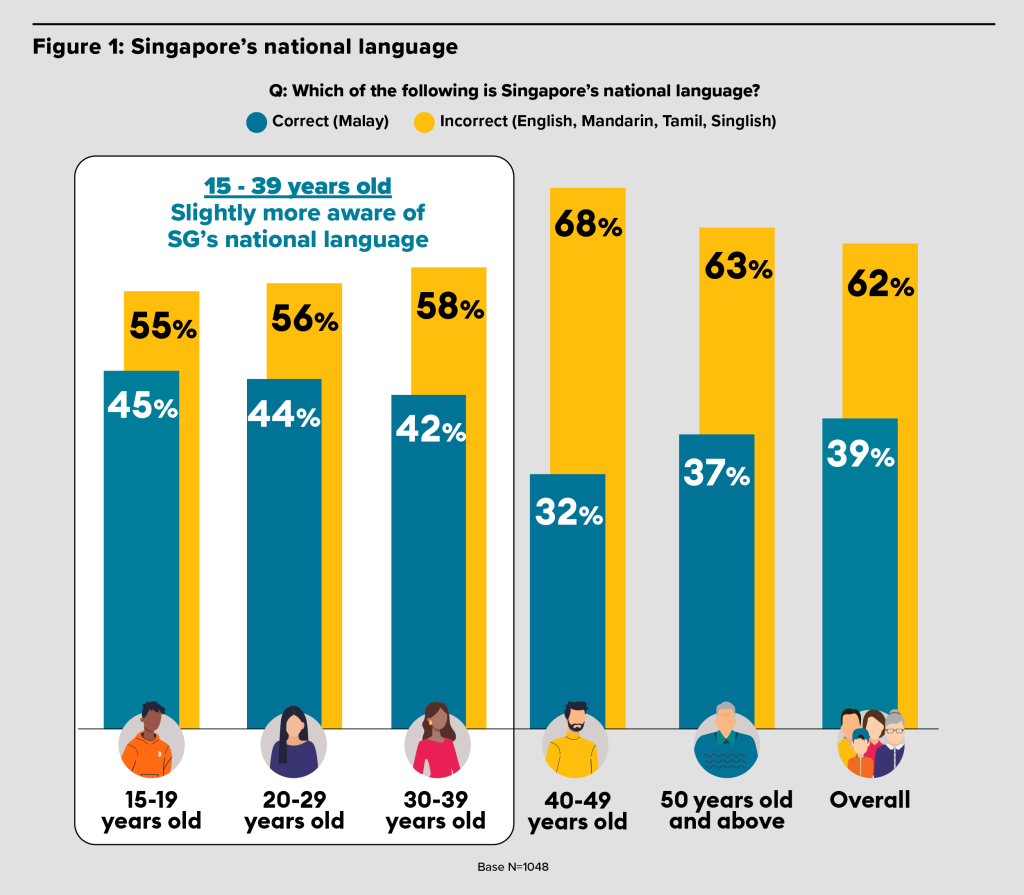
When we asked our respondents what Singapore’s national language was, we found that those in their 40s had the highest proportion of incorrect answers (68%). Younger respondents are comparatively more aware of the national language. (Figure 1)
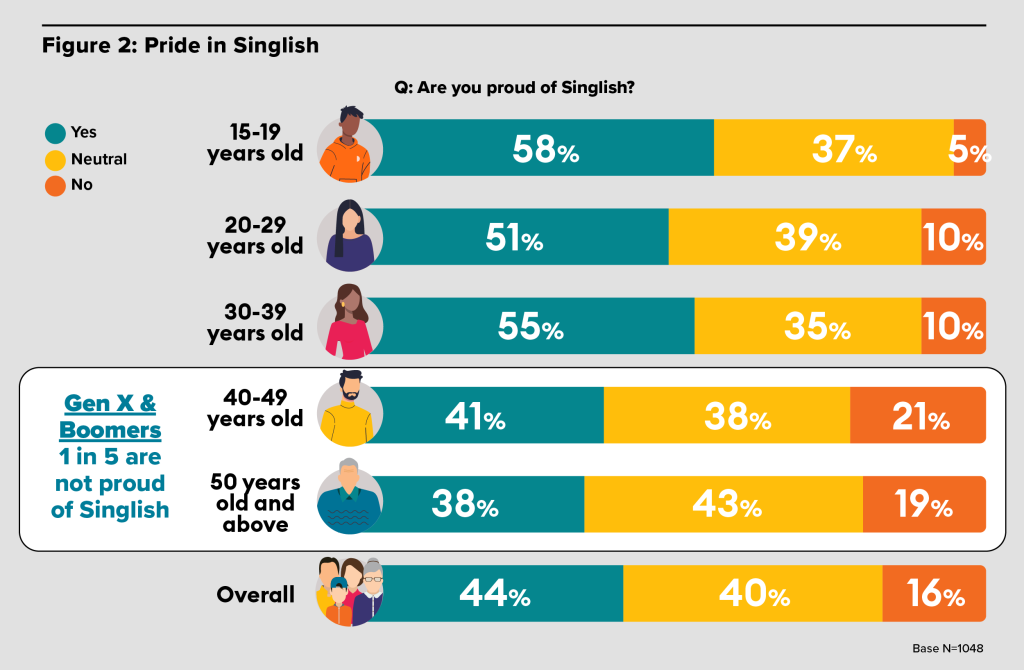
Pride in Singlish decreases with age
Surprisingly, while those above 40 grew up with Singlish, pride in Singlish generally decreases with age. Among all age groups, teens (aged 15-19) have the greatest pride in Singlish.
Singlish is mostly used in conversations with locals in casual settings
Singaporeans use Singlish mostly in informal conversations with locals (69%). Only 33% will speak Singlish with locals in formal settings. Singaporeans are generally quite confident in code switching from Singlish, with the mean confidence level in code switching at 77%.
High proportion feel that Singlish helps them better express themselves
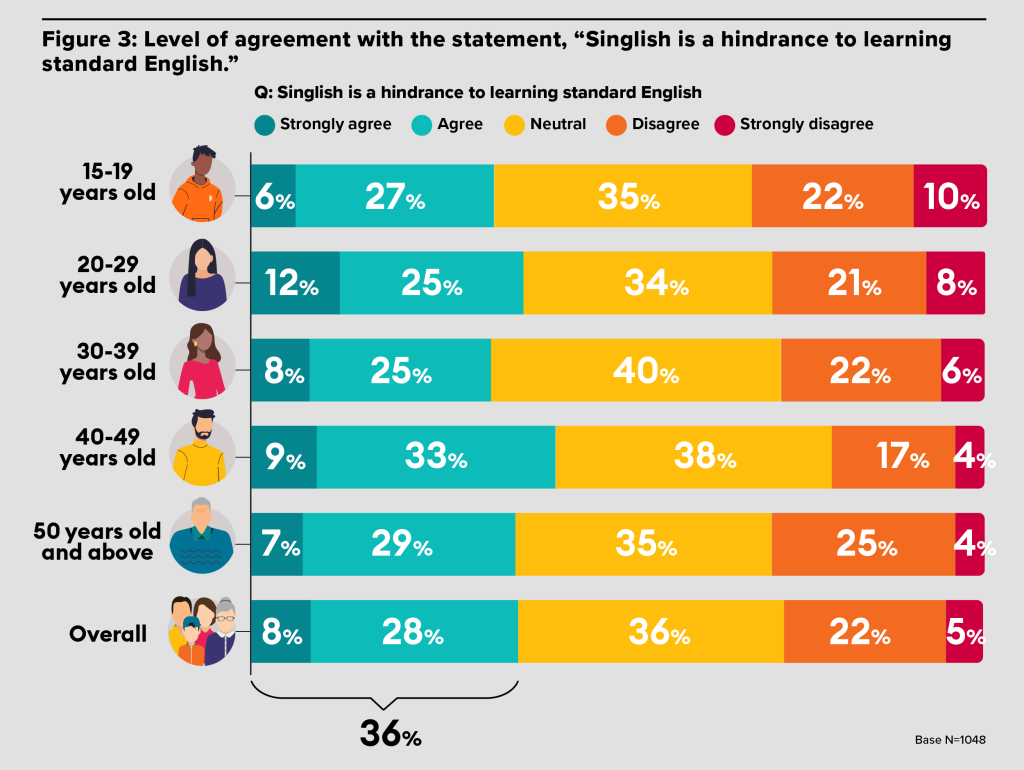
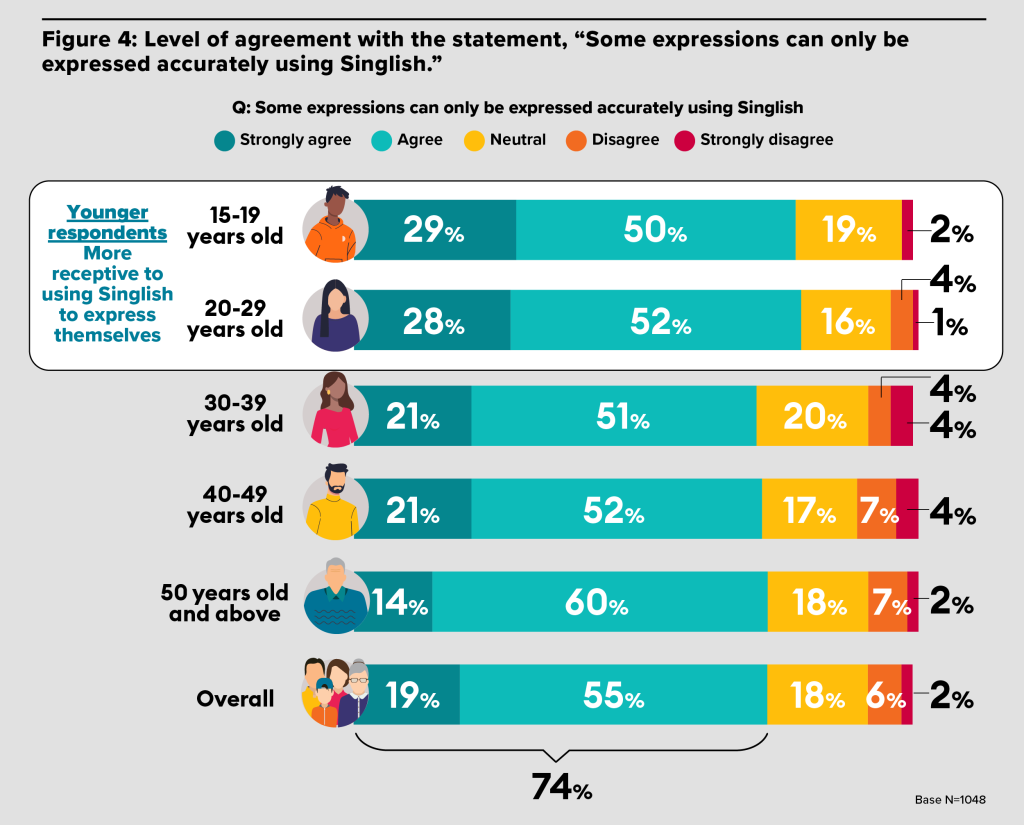
While 1 in 3 (36%, Figure 3) find Singlish a hindrance to learning standard English, 3 in 4 (74%, Figure 4) agree that Singlish helps them to express themselves better.
Consistent with our finding that the younger generation are prouder of Singlish, they are also more receptive to using Singlish to express themselves than the older generation. (Figure 4)
71% feel that Singlish is one of Singapore’s charms and 74% think that Singlish helps to bond Singaporeans together. Singlish is uniquely Singaporean. While our survey did not poll respondents specifically on this, generally, Singlish is easily understood by most Singaporeans, regardless of linguistic proficiency. It adds a touch of playfulness and common understanding to our conversations, allowing camaraderie to be built among those conversing. Finally, because it incorporates elements from Singapore’s official languages, Singlish allows Singaporeans to express their cultural identity with pride. It is clear from our poll that Singlish occupies a special place in the hearts of many Singaporeans.
For more insights from our study or on the future of work, drop us an email at [email protected].
Dating and getting married are still important to young Singaporeans
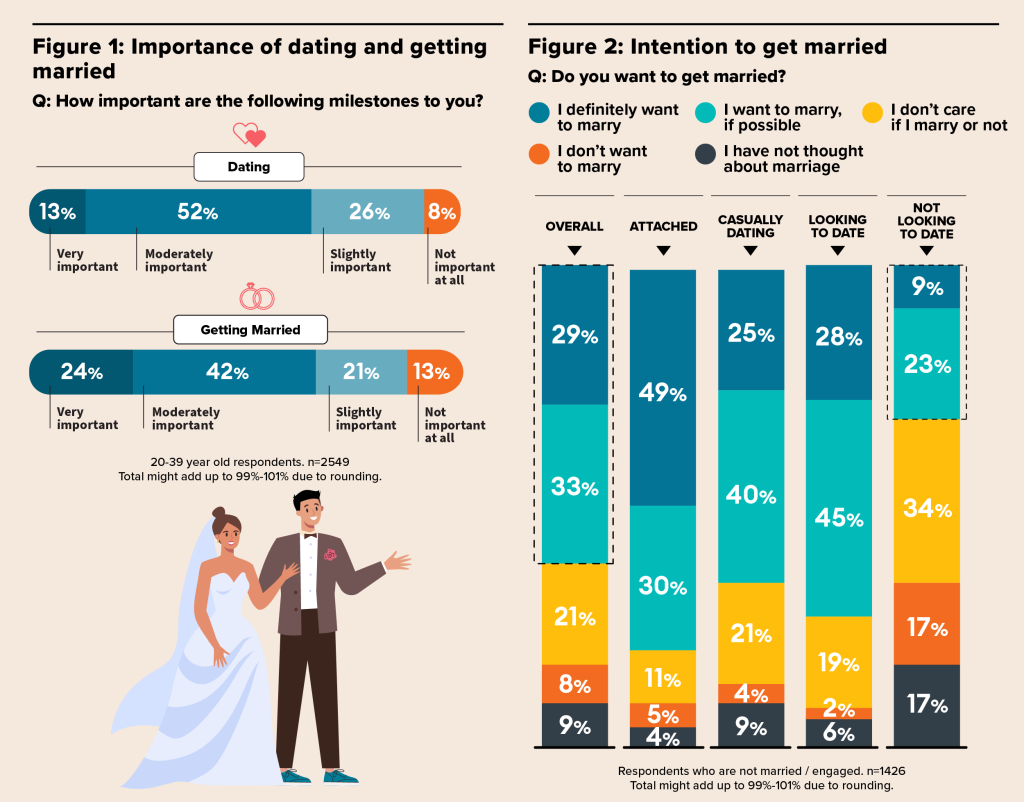
Close to 2 in 3 think that dating and getting married are moderately/very important milestones (Figure 1). Among those who are not married, 62% want to get married. Even among singles who are not looking to date, about 3 in 10 hope to get married if possible (Figure 2).
It is heartening to know that dating and marriage remain meaningful life goals for young people. So what’s stopping our young people from meeting their social aspirations?
Dating challenges
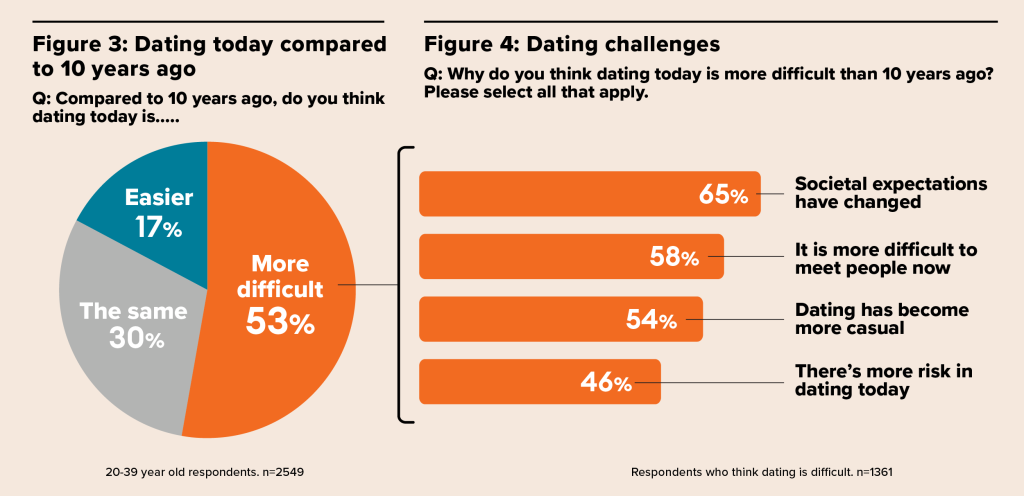
1 in 2 find the dating scene more difficult compared to 10 years ago (Figure 3). Change in societal expectations, increased difficulty in meeting people, and that dating has become more casual are the top 3 challenges (Figure 4).
To navigate this challenging dating landscape, what can be done to help young Singaporeans find their happily ever after?
Understanding what one seeks in a partner
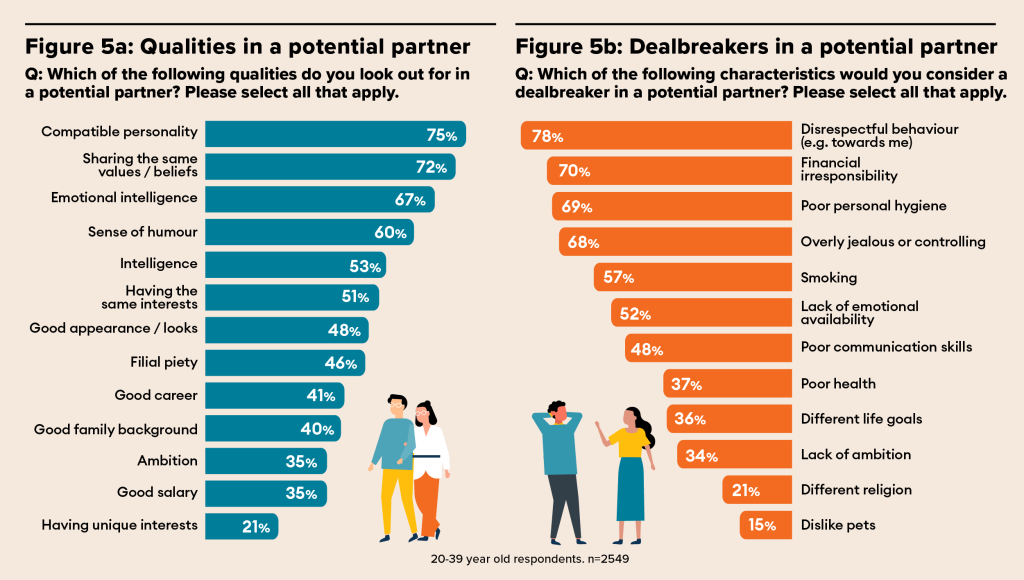
To start, it helps to understand what qualities young Singaporeans seek in a partner. The top 3 on the list are compatible personality, similar values and emotional intelligence (Figure 5a). Career and salary ranked lower on the list.
Equally important in this love equation is what young Singaporeans would not tolerate – disrespectful behaviour, financial irresponsibility and poor personal hygiene are among the top 3 dealbreakers (Figure 5b).
Through understanding their own expectations, young Singaporeans can align themselves with partners who genuinely reflect what matters most to them.
Seeking guidance from the social network
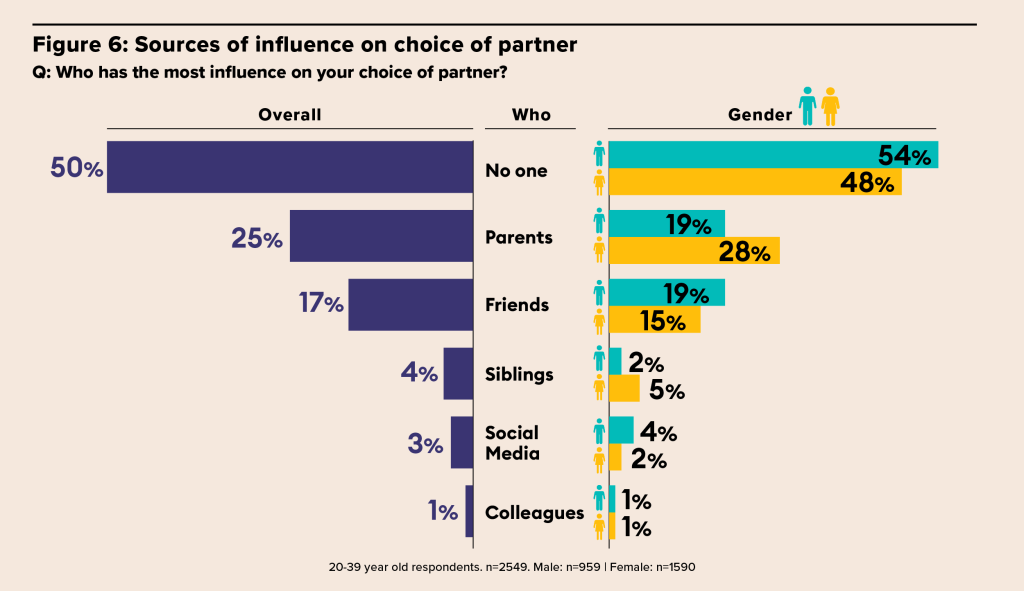
Dating is often seen as a private matter between two parties, but their social circles matter as well. While half indicated that no one has an influence on their choice of partner, the other half pointed to their social network as having an influence. Parents (28%) have a greater influence than friends (15%) among females, whereas both parents (19%) and friends (19%) have equal influence on males’ choice of partner (Figure 6). Given the meaningful role that the social network can play, parents and friends can share their own relationship experiences with young Singaporeans, offering support through relationship challenges.
Methods of meeting a partner
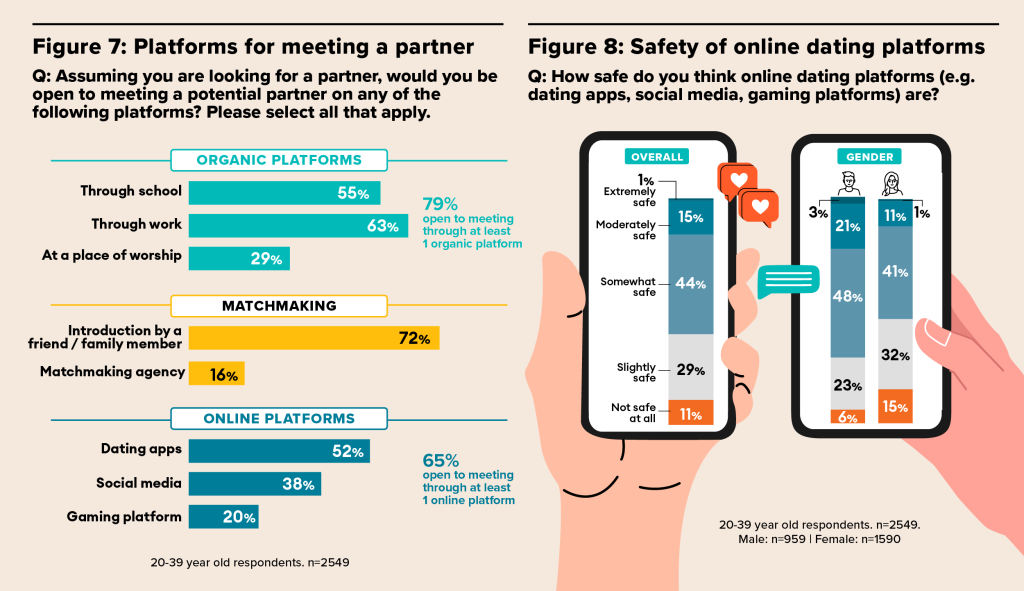
Organic meetings are the most preferred method of meeting a partner, with 79% open to meeting a potential partner through school, work or at a place of worship, and 72% open to introductions by a friend/family member (Figure 7).
In this digital age, online platforms have become increasingly common and a practical way to meet potential partners, with 65% open to using them (Figure 7). However, safety is a concern – about 16% think online platforms are moderately/extremely safe. Females are less likely to think so (Figure 8).
Towards finding meaningful relationships
While dating appears more complex and challenging today, the desire for connection is still significant among young Singaporeans. The insights from our research highlight the importance of understanding what young people seek in a partner, the influence of their social networks, and the role of both traditional and online platforms in meeting potential partners. By addressing these challenges and leveraging the support of their social circles, young Singaporeans can better navigate the complexities of modern dating and work towards finding their happily ever after.