Role of Singaporean Parents in their Children’s Education
Doing well in school is one of the important goals that Singaporeans want their children to achieve. How involved are parents in their children’s education and what are their parenting styles/approaches? To find out more, RySense surveyed 419 parents with school-going children from our online panel, HappyDot.sg, in February 2023. Here are our key findings:
Parents play an active role in their children’s academic achievement
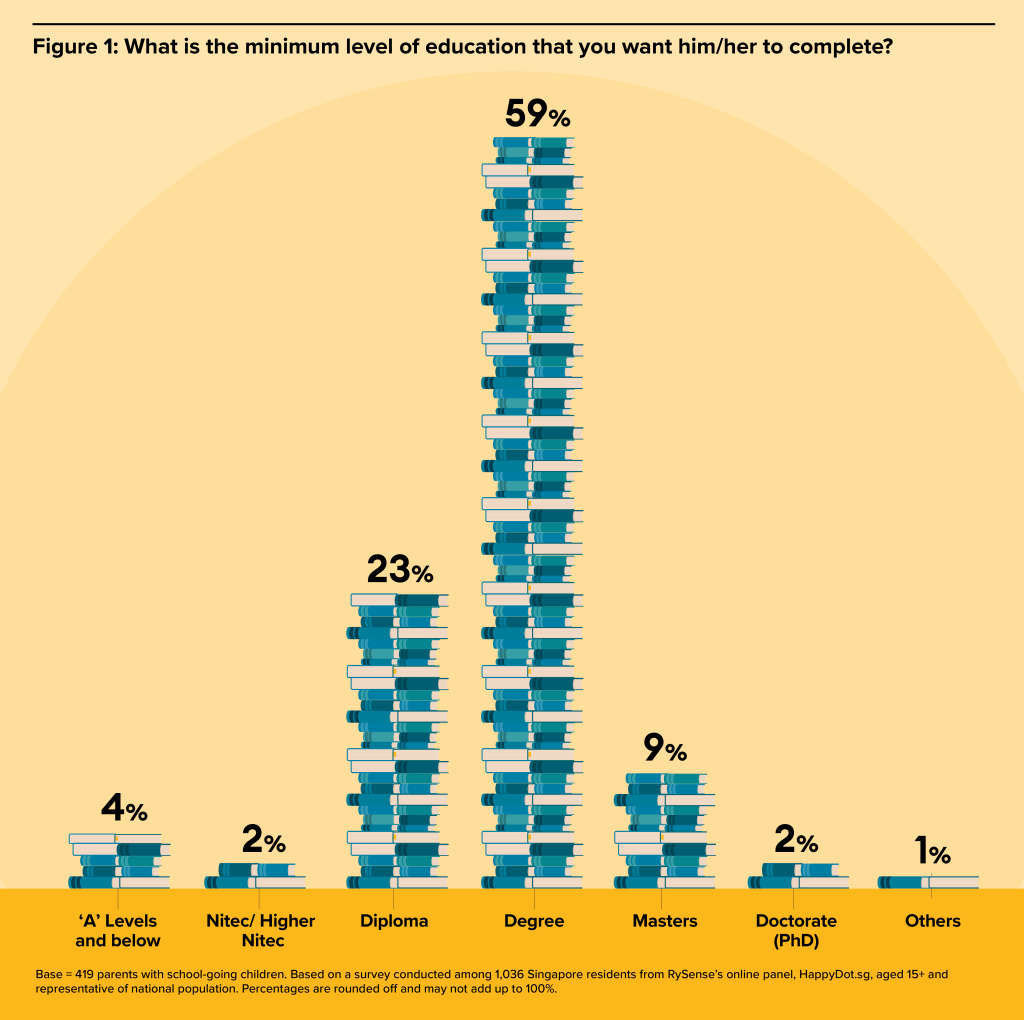
Parental involvement is a critical component in a child’s education. 8 in 10 (80%) parents agree/strongly agree with the statement “It is important for me to help my child to achieve good grades to succeed in Singapore.” When asked for their desired minimum level of education for their child to complete, 7 in 10 (71%) indicated a university degree or higher (Figure 1).
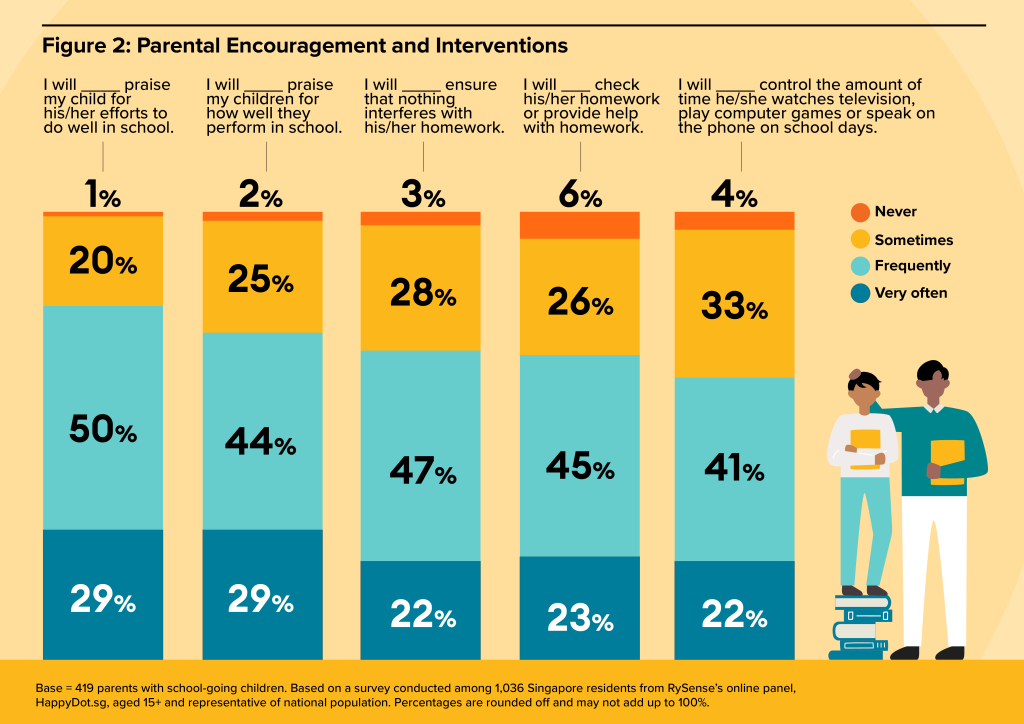
In helping their children keep up with school, parents adopt a combination of interventionist and ‘carrot’ approaches. 7 in 10 (67%) frequently/very often check or provide help with their child’s homework and ensure that nothing interferes with it. 6 in 10 (63%) control the amount of time their child watches television, plays computer games or speaks on the phone on school days frequently/very often. Additionally, parental encouragement plays a crucial role. 7 in 10 (73%) praise their children for how well they perform in school frequently/very often and 8 in 10 (79%) do so similarly for their children’s efforts to do well in school (Figure 2).
Less physical forms of discipline preferred
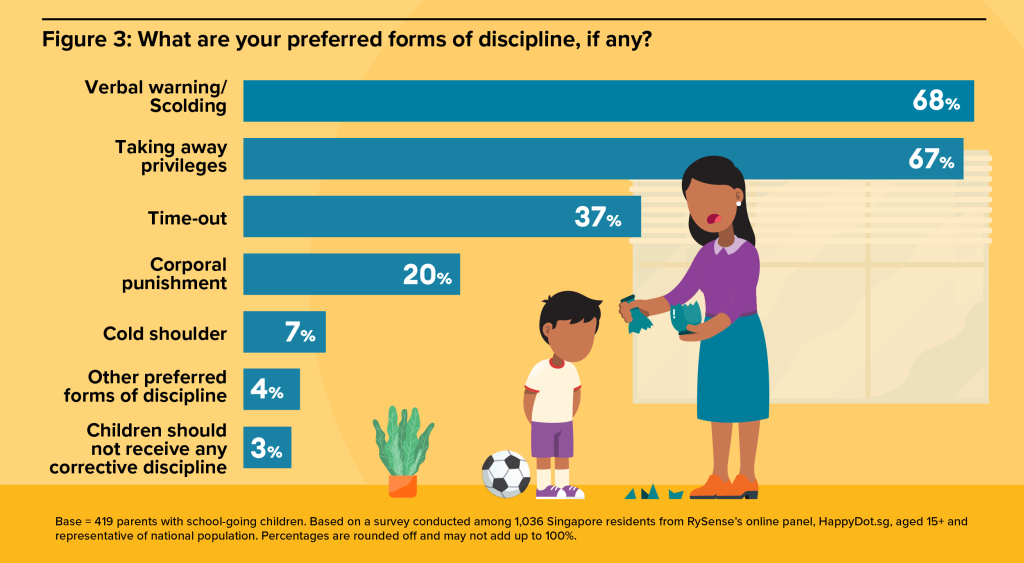
When their children do not meet their academic expectations, disobey or get out of hand, parents often implement disciplinary measures. The most preferred form of discipline is verbal warning/scolding (68%), followed by taking away privileges (67%). Corporal punishment emerged lower on the list, at 1 in 5 (20%). Interestingly, there is a minority who feel that children should not receive any corrective discipline (3%) (Figure 3).
Acceptance for alternative education pathways
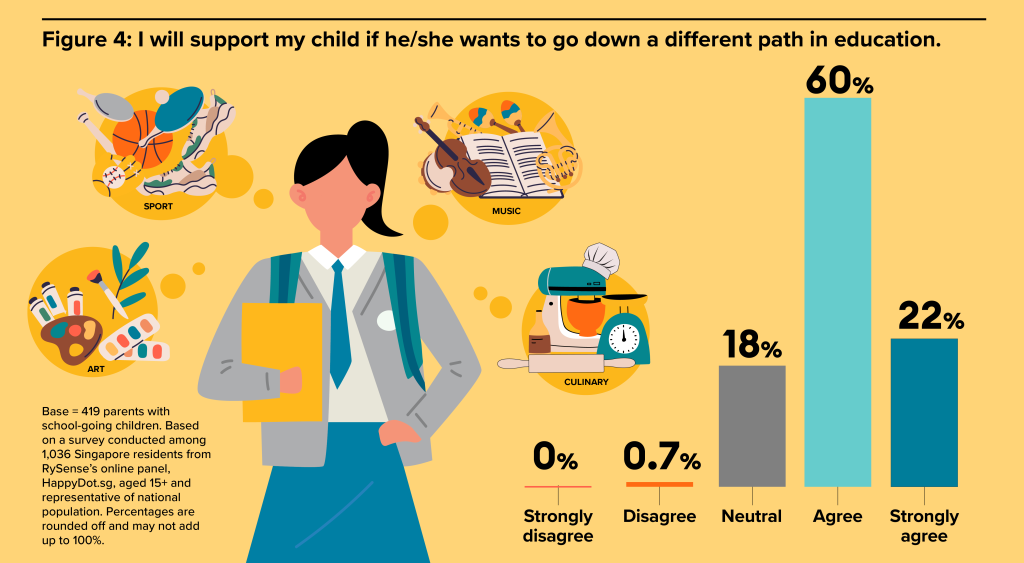
Despite the emphasis placed on academic achievement, 8 in 10 (81%) would support their children if they wanted to pursue a different path in education (Figure 4).
Even as expectations to succeed academically are high, it is encouraging to see broad acceptance for realising potential in more diverse areas.
For more insights on Singaporean parenting, drop us an email at [email protected].
Dating and getting married are still important to young Singaporeans
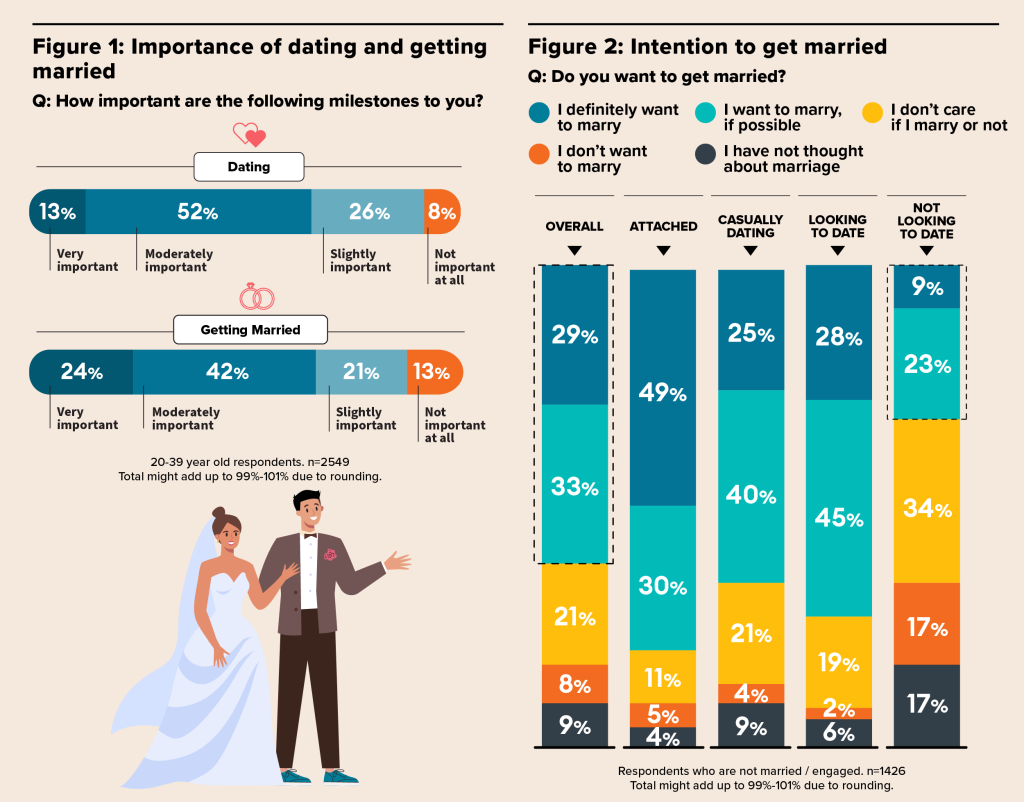
Close to 2 in 3 think that dating and getting married are moderately/very important milestones (Figure 1). Among those who are not married, 62% want to get married. Even among singles who are not looking to date, about 3 in 10 hope to get married if possible (Figure 2).
It is heartening to know that dating and marriage remain meaningful life goals for young people. So what’s stopping our young people from meeting their social aspirations?
Dating challenges
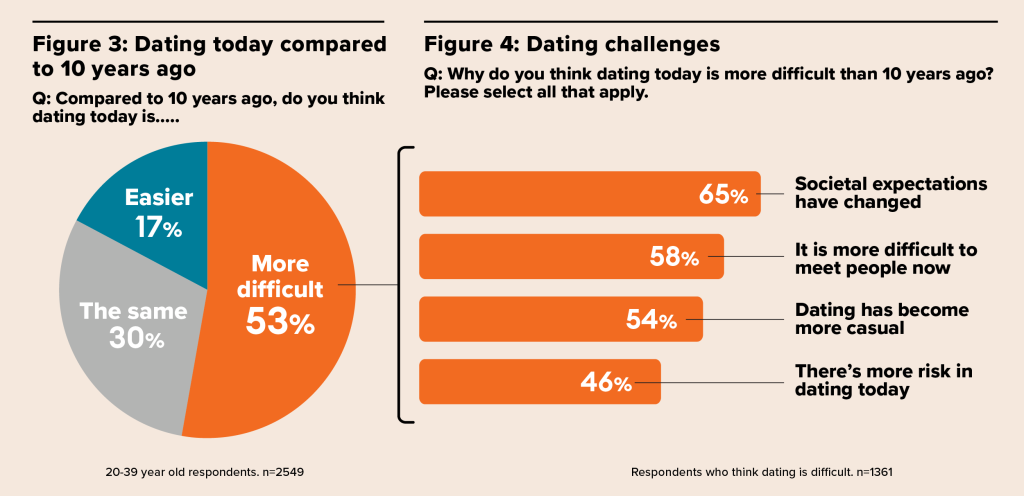
1 in 2 find the dating scene more difficult compared to 10 years ago (Figure 3). Change in societal expectations, increased difficulty in meeting people, and that dating has become more casual are the top 3 challenges (Figure 4).
To navigate this challenging dating landscape, what can be done to help young Singaporeans find their happily ever after?
Understanding what one seeks in a partner
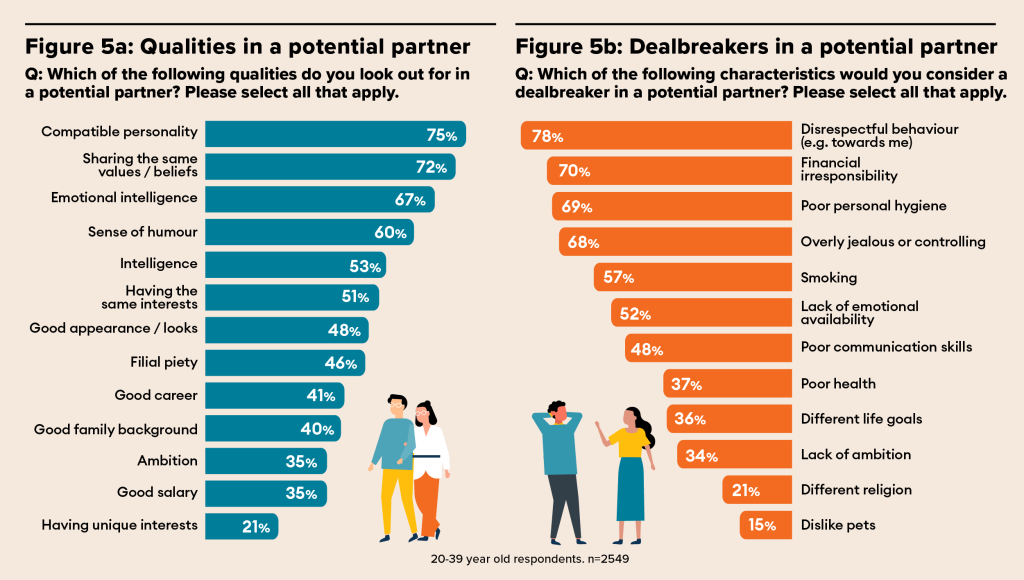
To start, it helps to understand what qualities young Singaporeans seek in a partner. The top 3 on the list are compatible personality, similar values and emotional intelligence (Figure 5a). Career and salary ranked lower on the list.
Equally important in this love equation is what young Singaporeans would not tolerate – disrespectful behaviour, financial irresponsibility and poor personal hygiene are among the top 3 dealbreakers (Figure 5b).
Through understanding their own expectations, young Singaporeans can align themselves with partners who genuinely reflect what matters most to them.
Seeking guidance from the social network
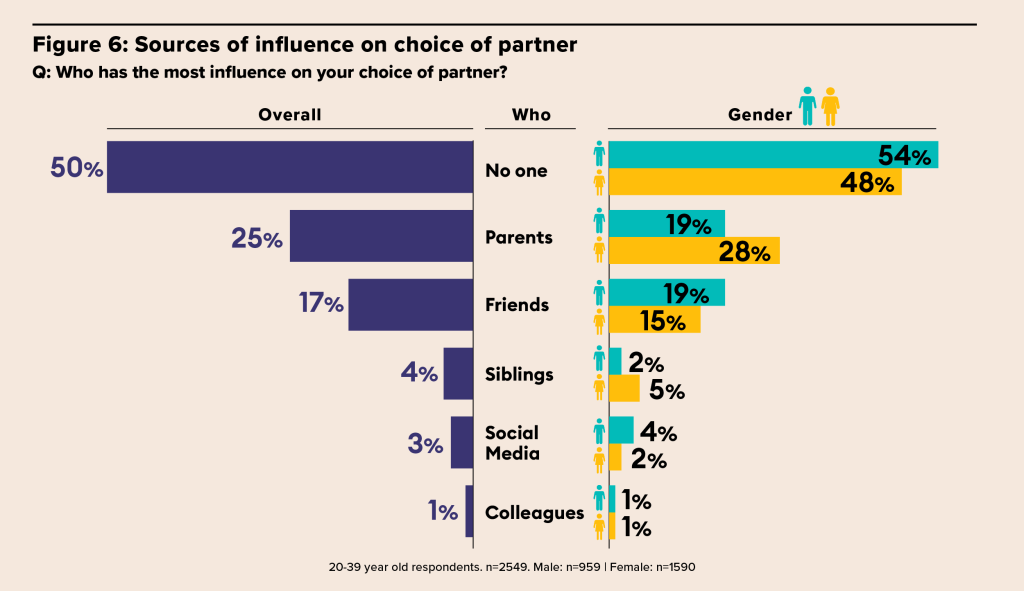
Dating is often seen as a private matter between two parties, but their social circles matter as well. While half indicated that no one has an influence on their choice of partner, the other half pointed to their social network as having an influence. Parents (28%) have a greater influence than friends (15%) among females, whereas both parents (19%) and friends (19%) have equal influence on males’ choice of partner (Figure 6). Given the meaningful role that the social network can play, parents and friends can share their own relationship experiences with young Singaporeans, offering support through relationship challenges.
Methods of meeting a partner
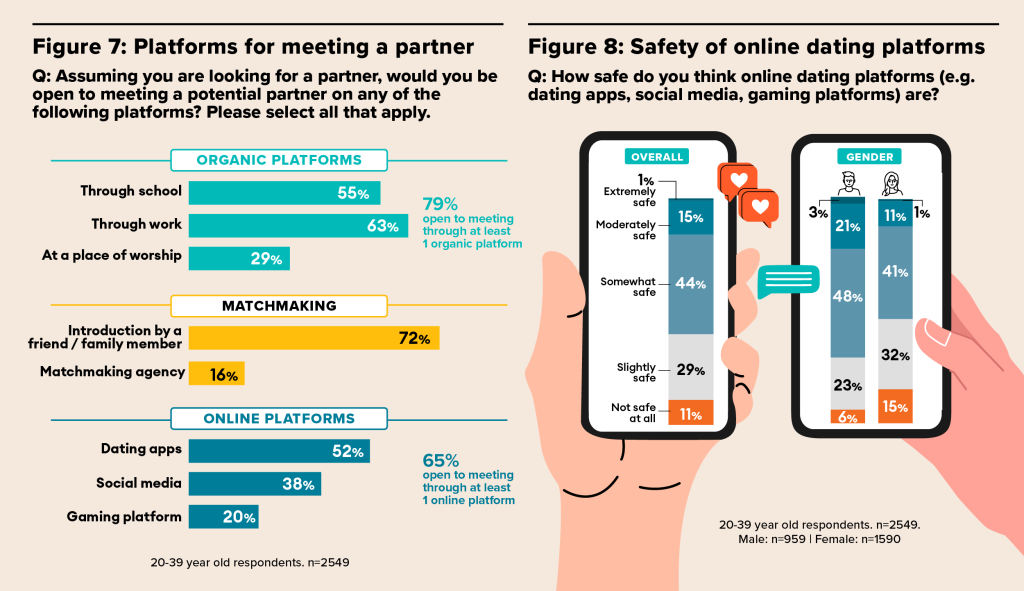
Organic meetings are the most preferred method of meeting a partner, with 79% open to meeting a potential partner through school, work or at a place of worship, and 72% open to introductions by a friend/family member (Figure 7).
In this digital age, online platforms have become increasingly common and a practical way to meet potential partners, with 65% open to using them (Figure 7). However, safety is a concern – about 16% think online platforms are moderately/extremely safe. Females are less likely to think so (Figure 8).
Towards finding meaningful relationships
While dating appears more complex and challenging today, the desire for connection is still significant among young Singaporeans. The insights from our research highlight the importance of understanding what young people seek in a partner, the influence of their social networks, and the role of both traditional and online platforms in meeting potential partners. By addressing these challenges and leveraging the support of their social circles, young Singaporeans can better navigate the complexities of modern dating and work towards finding their happily ever after.